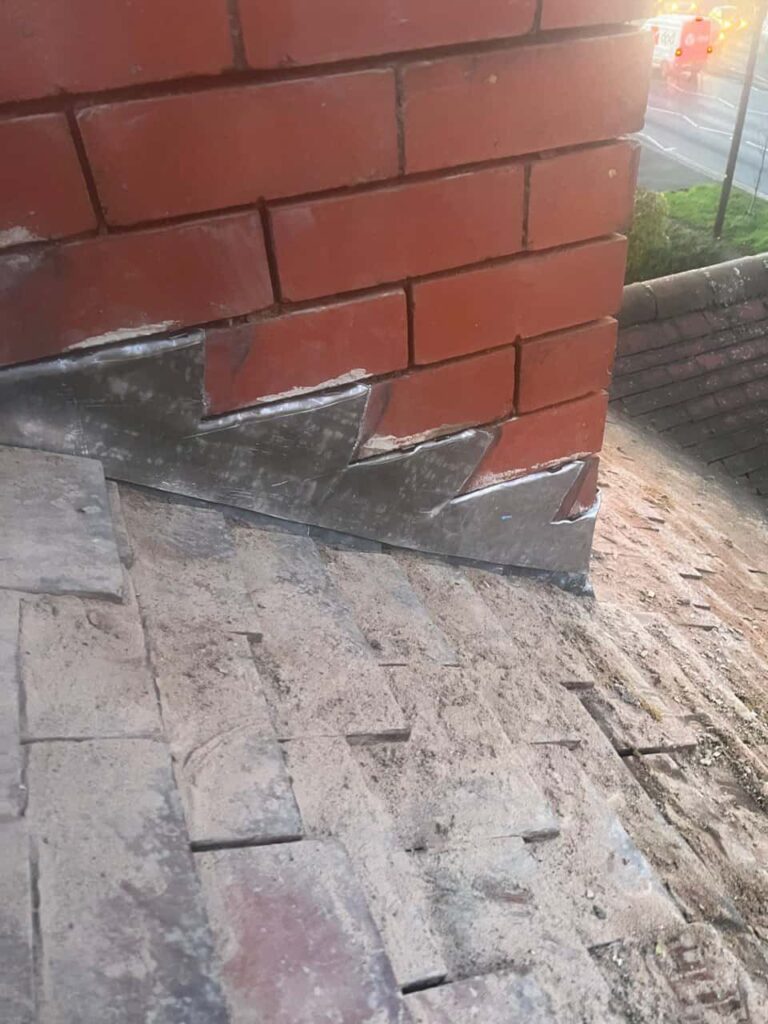
Lead flashing plays an important role in keeping a roof weather-resistant, particularly around areas where the main roof covering meets another surface or changes direction. It is commonly used to protect vulnerable junctions where tiles or slates alone cannot provide a reliable watertight transition.
When flashing becomes cracked, loose, displaced or otherwise deteriorated, rainwater can find its way behind the protective detail and into the roofing system. The resulting leak is not always immediately obvious. Water can travel beneath roof coverings or along internal materials before appearing as dampness somewhere inside the property.
For homeowners in Oldbury, West Midlands, recognising the importance of lead flashing can help explain why apparently minor deterioration around a roof junction should not simply be ignored.
How Does Damaged Lead Flashing Cause a Roof Leak?
Lead flashing is positioned to direct rainwater away from vulnerable roof junctions and back onto the external roof covering. When it remains secure and correctly formed, water should continue towards the normal drainage route rather than entering behind adjoining materials.
Problems can develop when the flashing:
- Cracks or splits
- Lifts away from adjoining surfaces
- Becomes loose or displaced
- Develops gaps at joints
- Deteriorates around fixings
- Separates from surrounding materials
- Becomes distorted or poorly seated
- No longer directs water effectively onto the roof covering
Even a relatively small opening can become an entry point during persistent or wind-driven rainfall.
Why Is Flashing Used Around Roof Junctions?
Roof coverings are effective across broad roof slopes, but additional detailing is needed where those slopes meet other parts of the property.
These junctions can be more vulnerable because rainwater is moving across changes in material, angle and direction.
Lead flashing creates a protective overlap at these points. Rather than allowing water to reach the joint directly, the flashing guides it towards the outer roof surface.
If this protective barrier is compromised, water can reach areas that were intended to remain covered.
Small Gaps Can Allow Significant Water Ingress
A damaged section of flashing does not need to contain a large opening before it becomes problematic.
Rainwater can be driven into surprisingly narrow gaps, particularly during windy conditions. Repeated exposure can allow moisture to pass behind the flashing and reach the roofing materials underneath.
This is one reason flashing defects can initially appear minor from ground level while producing noticeable dampness internally.
The important consideration is not simply the visible size of the defect, but whether it has created a route through which water can enter.
Cracked Lead Can Create a Direct Entry Point
Lead is durable, but it still experiences movement as temperatures change.
Where flashing has been incorrectly detailed, excessively restricted or has deteriorated over time, cracks can develop. Once a split forms, rainwater may pass through rather than being directed safely away from the junction.
The crack can also become more significant as movement continues.
A repair therefore needs to consider the condition of the surrounding flashing rather than concentrating solely on making the visible split disappear.
Loose Flashing Can Lift Away From the Roof
Flashing needs to remain securely positioned to perform correctly.
If part of it becomes loose, an opening can develop between the lead and the surface it is intended to protect. Rain can then be driven underneath the lifted section.
The defect may become particularly noticeable during certain weather conditions.
A roof might appear unaffected during light vertical rainfall but leak when stronger winds direct water towards the vulnerable junction. This can make intermittent flashing leaks difficult for homeowners to identify.
Displaced Flashing Can Change the Route of Rainwater
Lead flashing works partly by controlling where water travels.
If it moves out of position, water may no longer be discharged onto the intended part of the roof covering. Instead, it can be directed behind tiles, slates or adjoining materials.
This means that flashing does not need to contain an obvious hole to cause a problem.
A section that remains physically intact but is no longer correctly positioned may still allow water ingress.
Problems Can Develop Where Flashing Meets Other Materials
The junction between lead and neighbouring materials is particularly important.
If the flashing pulls away or the surrounding detail deteriorates, a gap can form along the interface. Water can then enter behind the lead rather than flowing over its outer face.
These junctions should therefore be assessed as complete details.
Repairing one visible point without examining the surrounding connection can overlook another weakness nearby.
Water May Travel Before Becoming Visible Indoors
One of the difficulties with diagnosing a flashing leak is that the internal damp patch may not sit directly below the damaged lead.
Once water enters the roofing system, it can travel along underlay, timbers or other surfaces before reaching a point where it becomes visible.
As a result, staining on a ceiling can sometimes appear some distance from the original roof defect.
This is why identifying the actual entry point is more reliable than assuming that the roof immediately above the internal stain must be responsible.
Damp Around a Chimney or Junction Deserves Investigation
Where internal dampness develops close to an area protected by flashing, the relevant roof junction should be inspected carefully.
However, the flashing should not automatically be blamed.
Nearby tiles, slates and other roofing components can also allow water ingress. A professional inspection should therefore consider the complete area and establish which defect is actually responsible.
Accurate diagnosis prevents sound flashing from being unnecessarily disturbed while ensuring that genuine deterioration is addressed.
Flashing Problems Can Be Intermittent
Some roof leaks do not appear every time it rains.
This can happen when the direction of the weather determines whether water reaches a particular defect. Wind-driven rain may enter behind loose flashing from one direction, while rainfall under calmer conditions causes no obvious problem.
This pattern can make the defect seem unpredictable.
Keeping track of when water ingress occurs can provide useful information during an inspection, particularly where the visible flashing damage is relatively subtle.
Repeated Dampness Can Affect Surrounding Materials
A flashing defect is not necessarily confined to the lead itself.
If water has been entering for an extended period, surrounding roof components may also have been exposed to moisture.
This is why repairing the visible flashing should be accompanied by consideration of the affected area where appropriate.
If surrounding materials remain sound, the repair may be straightforward and localised. Where deterioration has spread, additional attention may be required to restore the integrity of the complete junction.
Previous Flashing Repairs Should Be Assessed Carefully
A previously repaired flashing detail can sometimes develop another weakness.
This does not necessarily mean the original repair has failed. A neighbouring section may have deteriorated, or another part of the junction may now be allowing water through.
Where a leak returns, the complete relevant detail should be reassessed rather than automatically repeating the same repair.
Understanding whether the original defect has returned or a new one has developed helps avoid an unnecessary cycle of repeated work.
Why Temporary Surface Treatments May Not Solve the Cause
A flashing problem needs to be understood before deciding how it should be repaired.
Simply covering the visible area without identifying where water is entering may conceal the symptom without restoring the way the flashing is supposed to function.
The objective should be to create a sound junction that directs water correctly.
This requires consideration of the lead itself, its position, surrounding materials and the way the complete detail interacts with rainfall.
Not Every Flashing Defect Requires Wider Roof Work
Damaged lead flashing does not automatically indicate that the complete roof is deteriorating.
If the defect is localised and surrounding tiles, slates and supporting components remain serviceable, attention can often remain focused on the affected junction.
This is why assessment is important.
A proportionate repair should deal with the extent of deterioration actually present rather than assuming either that a small patch will always be sufficient or that a much larger roofing problem exists.
Why Early Attention Is Sensible
A small flashing defect may initially produce only occasional symptoms.
However, continued water ingress can expose surrounding roofing components to repeated moisture. What begins as a relatively contained weakness can therefore become more involved if it remains unresolved.
Having the problem assessed when staining, dampness or visible flashing deterioration first appears can help establish the cause while the affected area may still be limited.
The purpose is not to assume the worst, but to prevent an identifiable weakness from continuing unchecked.
Good Flashing Repairs Depend on Accurate Diagnosis
The visible condition of the lead is only one part of the investigation.
A roofer should consider where water is likely to be travelling, the condition of the complete junction and whether neighbouring roofing components are contributing to the problem.
This is particularly important when a property has experienced recurring water ingress.
Repairing the correct defect first time is more useful than repeatedly attending to the internal symptom without confirming where the moisture originated.
Why Professional Roof Assessment Matters
Flashing problems can be difficult to diagnose accurately from ground level because relatively small defects may be hidden within complex roof junctions.
At Oldbury Roofing Repairs, we focus on identifying the source and extent of water ingress before determining the appropriate repair. This includes assessing the relevant flashing together with surrounding roofing materials rather than assuming that the most visible defect tells the whole story.
For homeowners in Oldbury, West Midlands, this provides a condition-led approach where work can remain focused on the affected area when the surrounding roof remains sound.
Conclusion
Damaged lead flashing can allow water into a property when cracks, gaps, movement or displacement create a route behind the protective roof detail. Once moisture enters, it can travel beneath the covering before appearing internally, meaning the visible damp patch may not correspond directly with the original defect.
The most effective response is therefore to identify where the water is entering and assess the complete relevant junction. Localised flashing deterioration can often be addressed without unnecessary work elsewhere when the surrounding roofing remains serviceable.
If you have noticed signs of water ingress or deteriorated lead flashing at your property in Oldbury, West Midlands, contact Oldbury Roofing Repairs. We can assess the affected roof detail, identify the likely source of the problem and recommend an appropriate repair based on the condition found.
Call us on: 0121 312 1498
Click here to find out more about Oldbury Roofing Repairs
Click here to complete our contact form and see how we can help with your roofing needs.